A Multidimensional Poverty Understanding
When we think of poverty, we picture empty wallets and the inability to meet financial needs; but poverty is more complex. In the recent years, coupled with many studies on human development, poverty has been a topic of many debates with private and public interest; the more we emphasize on the meaning of poverty, the more we realize that poverty is multidimensional, encompassing far more than just income.
What is Poverty?
From an historically perspective, poverty has been defined by the lack of sufficient income; in other words, the inability to afford food, shelter, clothing; but in reality, poverty is much more than that.
In 1899, a British sociologist, Benjamin Seebohm Rowntree, did an investigation on poverty in the city of York; the results of that study were published in 1901 in a book entitled, Poverty, A Study of Town Life. The study found that poverty was even present within families with actual paying jobs. The research grouped the families into two categories:
- Primary poverty: families whose total earnings were insufficient to obtain the minimum necessaries for the maintenance of merely physical efficiency, such as food, shelter and the necessary basic.
- Secondary poverty: Families whose total earnings would have been sufficient for the maintenance of merely physical efficiency but were not because it was absorbed by other expenditure.
The investigation, which was conducted from house-to-house, reported 20.302 people as living in poverty, which at that time represented 28% of the total population. From these numbers, 10% were living in primary poverty, while 17% in secondary poverty.
The Nobel Memorial Prize winner in Economic Sciences, Amartya Kumar Sen, concluded that poverty is more appropriately viewed in terms of the absence or limited access to opportunities for human development rather than merely as low income which is the standard identification of poverty. Therefore, he concluded that poverty is the deprivation of freedoms and lack of opportunities, including work, medical coverage, public health care, sanitation (clean water, good sewage system), education, law and order, protection from violence (including domestic violence), safe work environment
In the lens of the definition of Amartya Kumar Sen, Katarina Pitasse Fragoso, concluded in a research article that poverty means a lack of basic capabilities originating directly or indirectly from long-standing structures of oppression due to past events, social norms and cultural attitudes which constrain when, where and how a person or group can access resources and valuable relations in society.
In 2010, the Oxford Poverty & Human Development Initiative (OPHI) and UN Development Programme (UNDP) launched the Global Multidimensional Poverty Index (MPI), to measure acute multidimensional poverty covering over 100 developing countries. The MPI have introduced a 3-dimensional measure of poverty with 10 weighted indicators, allowing them to measure poverty at an individual level. The conclusion is, if a person is deprived in a third or more of ten (weighted) indicators, that person is identified as MPI poor. The extent, or intensity, of that person’s poverty is also measured through the percentage of deprivations he/she is experiencing.
Global Poverty
In 2024, MPI reported 1.1 billion people living in poverty. The report compared data from 112 countries, these countries were divided among 21 low-income countries, 87 middle-income countries and 4 high-income countries totalling 6.3 billion people; which represented 92% of the population in developing regions.
The in-depth analyses further reported:
- 40% of the 1.1 billion people living in poverty live in countries experiencing war, fragility and/or low peacefulness.
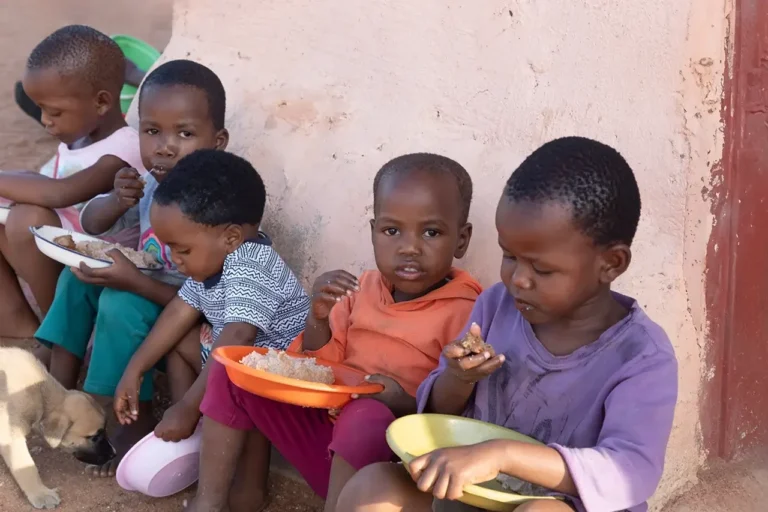
- Over 50% of the 1.1 billion people living in poverty are children under the age of 18. Global numbers show that 27.9% of children live in poverty, compared with 13.5% of adults.
- A large proportion of the 1.1 billion people living in poverty lack adequate sanitation (828 million) and housing (886 million).
- Well over half of the 1.1 billion people living in poverty live with a person who is undernourished in their household (637 million). In South Asia 272 million poor people live in households with at least one undernourished person, and in Sub- Saharan Africa 256 million do.
Poverty is not Just a Problem in Developing Countries
The MPI reported data from 112 countries; with a strong focus on Sub‑Saharan Africa and South Asia. however, severe poverty also exists in middle-income and high-income nations.
- According to Business Insider, more than 10% of Americans live below the federal poverty line, and more than 25% are just above the poverty threshold. One in five adults have no to very limited retirement savings, and millions of baby boomers now relies merely on Social Security checks, facing huge difficult to afford housing, food, and healthcare.
- For the OECD countries, the poverty rate was 11.4% in 2021 (i.e. the share of people living with less than half the median disposable income in their country).
- The United Kingdom is one of the richest countries in the world; nonetheless, 4.5 million children live in poverty, with children in lone-parent families in even higher risk.
The Other Faces of Poverty
From our earlier definitions, we concluded that poverty is more than a lack of income. Poverty has many faces that are often overlooked.
Some of these faces are not limited to:
- Social and Emotional Isolation
- Mental and Physical Deprivations and Health
- Intergenerational Poverty and Family Stress
It is important to understand that only focusing on income poverty data is no longer sufficient. A multidimensional approach is necessary with targeted interventions to understand the real underlying impact of poverty; because there are many families living above income poverty but still lacking clean water or electricity or may even suffer chronic illness; syncing them deeper in a broader poverty ecosystem.
What Can The Responsibles Do?
At The Responsibles Foundation, we believe:
- Poverty is not just about a lack of income; it is multidimensional.
- Effective policies must tackle capabilities: not just income focus solutions. Future solutions must also include mental health, community rebuilding, caregiving infrastructure, and reconciliation of generational disparities.
- We see that high-income nations also have vulnerable populations. Consequently, poverty is across all socioeconomic layers, including, income inequality, policies, housing crises, and welfare.
The Responsibles Foundation; therefore, aim to
- Adopt multidimensional approaches locally
- Invest in relational and social infrastructure
- Break intergenerational cycle
- Protect vulnerable caregivers
Join us and help us build capable, connected, and caring communities, because ending poverty is about more than just income.
Sources:
- Seebohm Rowntree, B. (1901). Poverty, A Study of Town Life
- Amartya Kumar, S. Definition of Poverty.
- Pitasse Fragoso, K. (2024). Poverty as capability deprivation: Considering the relational approach, group-based analysis, and socio-structural lens.
- Oxford Poverty & Human Development Initiative (OPHI) and UN Development Programme (UNDP). (2010). What is the Global MPI.
- Global MPI 2024
- UNDP: 1.1 billion people live in multidimensional poverty, nearly half a billion of these live in conflict settings
- Many boomers on Social Security live near poverty and don’t tell anyone. It’s adding to the loneliness crisis.
- Society at a Glance 2024: OECD Social Indicators.
- Child poverty.